The Real Cost of a Weak Password
A weak password can look harmless. It may feel like a practical shortcut, something easy to remember on a busy day. Yet one simple password reused across accounts can create consequences far bigger than most people expect. In cybersecurity, one of the most common failures is also one of the most avoidable.
People often choose weak passwords for understandable reasons. They are managing many accounts, moving quickly, and trying to reduce mental overload. Names, birthdays, phone numbers, or familiar words feel convenient because they are easy to recall. The problem is that attackers understand this pattern extremely well. Automated tools can test huge numbers of predictable combinations in seconds, and once one account is exposed, others can quickly follow.
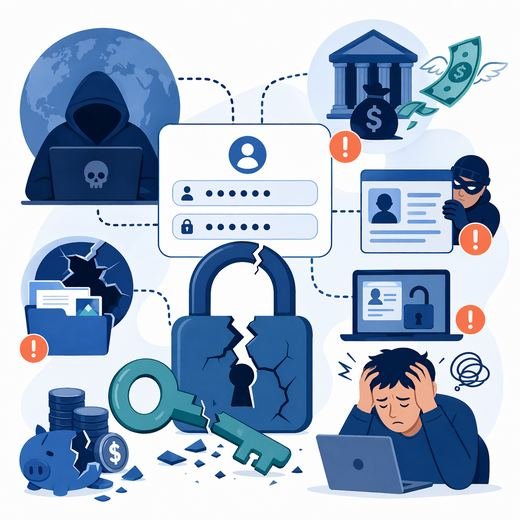
The real damage rarely stops at a single login. If someone uses the same password for email, shopping, social media, and banking, the first compromised account becomes a doorway to the rest. Email access is especially dangerous because it often controls password resets for many other services. From there, a criminal may move into financial accounts, cloud storage, or identity-related platforms without needing to break through multiple barriers.
For businesses, weak passwords create similar risks at a larger scale. One employee account with poor security can open paths into internal systems, shared documents, customer data, or payment platforms. Companies sometimes spend heavily on firewalls and monitoring tools but still leave themselves exposed through weak credential practices. In many breaches, the point of entry is not some advanced technical exploit. It is a password that was too simple, too old, or reused too widely.
This is why modern security advice has moved away from impossible-to-remember complexity rules alone. What matters more is creating passwords that are long, unique, and difficult to guess. A strong passphrase made of unrelated words can often be more secure and easier to remember than a short, complicated string built around a predictable pattern. The goal is not to create frustration. It is to create resilience.
Password managers have also changed the conversation. Many people resist them at first because they sound unfamiliar or risky. In practice, they often solve the biggest human problem in password security: memory. A good password manager lets users create strong, unique credentials without relying on repetition or guessable shortcuts. That makes security more realistic, not less.
Multi-factor authentication adds another valuable layer. Even if a password is exposed, a second verification step can stop an attacker from moving forward. This does not make passwords irrelevant, but it makes them part of a stronger system rather than the only gate protecting valuable information.
The wider lesson is simple. Weak passwords are not just a personal convenience issue. They are a security risk with financial, emotional, and operational consequences. People tend to think about passwords only when logging in, but their quality matters long after that moment passes.
Cybersecurity often feels complex, yet this is one area where better habits can make an immediate difference. Strong passwords, unique credentials, password managers, and multi-factor authentication are not dramatic solutions. They are practical ones. And in digital security, practical habits often prevent the biggest regrets.