What Secure Remote Work Really Requires
Remote work expanded rapidly for many organizations, and with it came a major cybersecurity challenge. At first, the conversation often focused on convenience: video meetings, cloud collaboration, home connectivity, and flexible schedules. Over time, however, it became clear that remote work is not simply office work in a new location. It creates a different security environment with different habits, risks, and responsibilities.
In a traditional office, many security controls sit quietly in the background. Devices may be centrally managed, networks may be monitored, and access paths may be more predictable. At home or on the move, those layers can become weaker or more fragmented. Employees may use personal Wi-Fi, shared spaces, personal devices, or mixed work and home accounts in ways that expand exposure.
One of the biggest remote-work risks is the erosion of boundaries. Sensitive documents may be opened in casual environments. Work messages may arrive through multiple devices. Users may move between trusted business tools and personal apps without thinking much about the security difference. When work becomes more flexible, attention has to become more intentional.
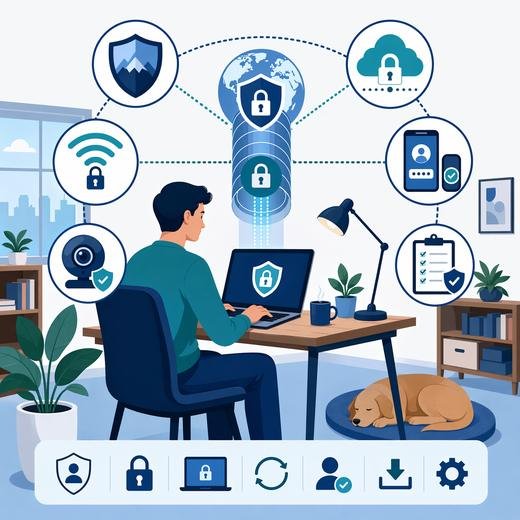
Strong remote security begins with devices. Laptops, tablets, and phones used for work should be updated, encrypted, and protected with strong authentication. If organizations allow personal devices, the rules should be clear. Ambiguity creates risk. People need to know what is permitted, how data should be stored, and what to do if a device is lost or compromised.
Identity is equally important. Multi-factor authentication, limited privileges, and careful account management are essential in remote settings. Since workers are no longer protected by office location alone, authentication becomes one of the most valuable controls. A strong login process may seem like a small inconvenience, but it can prevent major compromise.
Remote work also changes the social side of security. Employees may be more vulnerable to phishing and impersonation when they cannot easily verify a request in person. A fake message from a manager, a fraudulent invoice, or an urgent request to share a file may seem believable when everyone is already communicating through screens. Verification processes must adapt to that reality.
Organizations often make a mistake when they treat remote security as only a technical deployment problem. It is also a habit-building problem. Employees need guidance that feels practical: how to secure home Wi-Fi, when to use a VPN, how to recognize suspicious requests, where to store files, and how to report concerns quickly. Clear expectations reduce guesswork.
Remote work can absolutely be secure, but not by accident. It requires design, training, device hygiene, account protection, and a culture that respects the difference between working anywhere and working safely anywhere. The more distributed the workforce becomes, the more important those fundamentals become.
In the end, secure remote work is not about recreating the office perfectly. It is about building a security model that matches how people actually work now. That means recognizing flexibility as both an opportunity and a responsibility.
Secure remote work also depends on leadership example. When managers follow the same rules they expect from others, security feels like a shared standard rather than an obstacle imposed from above.