Will AI Replace Jobs or Transform Them?
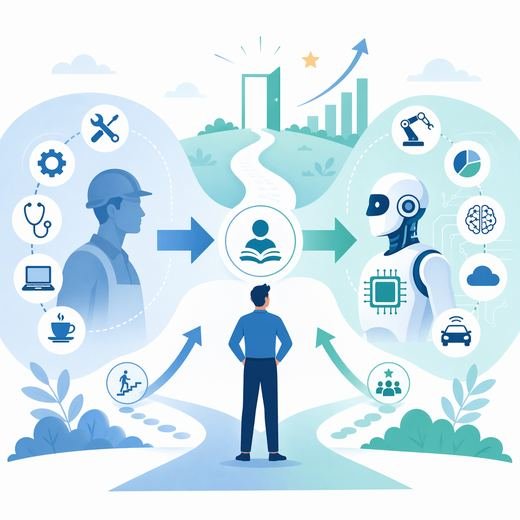
Few technology questions create as much anxiety as the idea that artificial intelligence will replace human jobs. The fear is understandable. People have seen automation change factories, offices, and service industries before, and AI appears capable of moving into areas once thought securely human. It can write summaries, analyze data, answer customer questions, generate images, and complete routine tasks at remarkable speed. But the future of work is usually more complicated than simple replacement.
Throughout history, technology has often removed certain tasks while creating new roles, new expectations, and new industries. Artificial intelligence is likely to follow a similar pattern, though the pace may feel faster. Many jobs are made up of multiple tasks, not one single function. AI may automate parts of a role without eliminating the entire role. A marketer may use AI to draft ideas but still need strategy and judgment. A lawyer may use AI to review documents faster but still rely on human reasoning and client trust. A teacher may use AI tools for lesson planning while remaining essential for guidance and care.
This distinction between jobs and tasks matters. If AI takes over repetitive or highly structured work, people may spend less time on routine processing and more time on communication, decision-making, creativity, and relationship-building. That can be positive when organizations use the technology to support workers rather than simply cut labor. The same tool that threatens one role can also enhance another.
Some sectors will feel disruption more strongly than others. Administrative work, basic customer support, data entry, and standard content production are especially vulnerable because they rely on patterns that software can learn relatively well. On the other hand, jobs requiring emotional intelligence, physical adaptability, ethical judgment, leadership, and complex human interaction are less easily replaced. Even in technical fields, the need for oversight often grows as systems become more powerful.
New roles are already emerging. Businesses need people who can manage AI systems, review outputs, improve prompts, protect data, and ensure compliance. There is growing demand for professionals who understand both the technology and the human context in which it operates. In that sense, AI is not only eliminating tasks. It is also changing what skills become more valuable.
Still, optimism should not become denial. Some workers will face real displacement, and not everyone will transition easily. Reskilling takes time, money, and support. Communities built around shrinking job categories can feel these changes deeply. If businesses and governments treat the transition as purely technical, they risk creating avoidable social pain. The future of work will depend not only on what AI can do, but on how institutions choose to manage change.
For individuals, adaptability may become the most important career skill. People who can learn new tools, communicate clearly, solve problems, and work alongside intelligent systems will likely remain in strong demand. Technical ability matters, but so do flexibility and judgment. In many roles, the winning combination will be human strengths supported by machine efficiency.
The real question may not be whether AI will replace jobs, but which parts of work should remain human and which can be improved through automation. That is a more useful conversation because it focuses on design, not fear. Jobs are not static objects. They evolve.
Artificial intelligence will transform work, and in some cases it will replace certain tasks or roles. But its broader impact is likely to be a reshaping of how work is done, what skills matter most, and where human value becomes even more obvious. The challenge is making sure that transformation serves people, not just productivity metrics.