AI and the Future of Small Businesses: Opportunity for Those Who Adapt
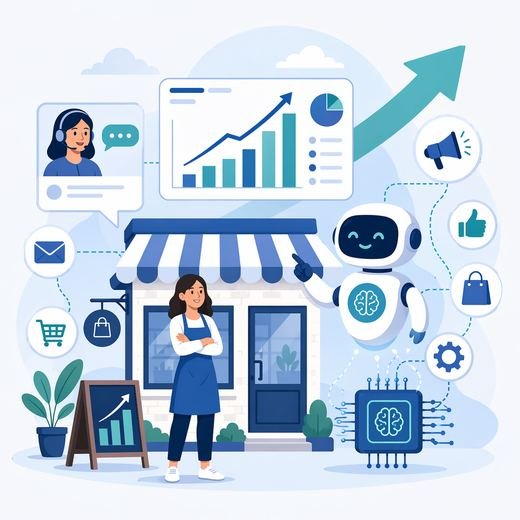
Small businesses often face a familiar challenge: they must compete in markets shaped by larger companies with bigger budgets, larger teams, and stronger technical infrastructure. For a long time, advanced technology often widened that gap. Artificial intelligence is beginning to change the equation. While large organizations still have major advantages, AI tools are becoming accessible enough to give smaller businesses new ways to operate more efficiently, serve customers better, and grow with less waste.
One of the biggest advantages for small businesses is automation. Owners and lean teams spend enormous energy on repetitive tasks such as scheduling, answering common customer questions, drafting product descriptions, managing stock alerts, or organizing leads. AI can reduce that burden. Even small improvements matter when a business is running with limited time and staffing. If a shop owner saves several hours a week on routine work, that time can be redirected toward sales, service, and strategy.
Customer communication is another area where AI can help. Small businesses often succeed because they feel more personal than large companies, but maintaining that personal touch consistently takes effort. AI-assisted tools can help respond to messages faster, recommend products, segment customer groups, and tailor offers based on behavior or buying history. Used well, these tools do not remove the human character of a small business. They help support it with better timing and organization.
Marketing has become one of the clearest entry points. AI can assist with writing social captions, improving ad copy, analyzing campaign results, and suggesting content ideas. A small business that once struggled to maintain a regular online presence can now create and test material more efficiently. This matters because visibility is often one of the hardest battles for smaller brands. Consistency improves when the workload becomes more manageable.
AI can also support better decision-making. Forecasting demand, analyzing reviews, spotting buying trends, and understanding customer patterns were once tasks that required expensive systems or outside expertise. Today, many software platforms offer these capabilities in simpler forms. A small retailer can notice which products are rising in popularity, when certain promotions work best, or where friction appears in the customer journey. Better information supports smarter choices.
Still, opportunity does not guarantee success. The small businesses that benefit most from AI are likely to be the ones that use it selectively and realistically. Buying a tool because it sounds impressive is not the same as solving a real operational problem. Owners need to ask clear questions: what task is slowing us down, where do mistakes repeat, and what process could become easier with support? Practical use matters more than trend-chasing.
There are also risks. Poorly used automation can make a business feel cold or generic. Customers often choose small businesses because they want authenticity and trust. If AI-generated communication becomes careless, inaccurate, or impersonal, it can damage the very advantage that made the business attractive in the first place. Human review still matters.
The future of small business will not belong only to the biggest companies with the most technology. It may increasingly belong to those who know how to combine tools with agility, personality, and close customer understanding. Small businesses can move faster, adapt quicker, and stay closer to what customers actually want.
Artificial intelligence offers real opportunity for small businesses, but the reward will go to those who adapt with intention. The technology itself is not the advantage. The advantage comes from using it to save time, improve decisions, and strengthen the human qualities that make small businesses worth choosing.